Published June 2026 by FastPlus Abrasives USA — fastplus.us — Last reviewed: June 2026
At a Glance
| Topic |
220 grit ceramic sanding discs and rolls for between-coat sanding |
| Who needs this |
Woodworkers sanding between finish coats, cabinet painters scuffing primer, auto body techs leveling sealer, anyone applying lacquer or water-based polyurethane |
| Products in stock |
4 products — all ceramic, 6-inch discs and 2.75-inch rolls only |
| Formats |
6" disc (47H universal, 119H Mirka), 2.75" roll (H&L chevron, PSA) |
| Notable gaps |
No 5-inch disc at 220 grit. No aluminum oxide at 220 grit. F65 Blue (5" and 6" 49H) skips 220 grit entirely (180 to 240). F25 Yellow (5" and 6") also skips 220 grit. |
| Source |
fastplus.us/collections/220-grit-sanding-discs |
Key Takeaways
- Only 4 FastPlus products carry a 220 grit variant — all ceramic, all 6-inch disc or 2.75-inch roll. No 5-inch disc and no aluminum oxide option exists at this grit.
- 220 grit is the standard between-coat grit for lacquer, conversion varnish, and water-based polyurethane — it scuffs the cured coat just enough for the next layer to bond.
- The FF78 47H Universal disc skips 180 grit but returns at 220 grit — making it the only universal-fit 6-inch ceramic option at this grit.
- At 220 grit, light touch matters more than abrasive type — you are scuffing a cured finish, not removing material. Disc consistency across the panel is what matters.
- The PSA and hook-and-loop rolls in 220 grit are well suited for scuffing large flat panels between coats — longboard blocks keep pressure even across the surface.
- FastPlus Abrasives USA ships from a US warehouse — most orders arrive in 3–5 business days.
Between Coats: The Sanding Nobody Talks About Until the Finish Looks Wrong
Most finishing problems that show up in the final coat were created between coats. Dust nibs that were not knocked down. Raised grain that was not leveled. A sealer coat that was not scuffed before the topcoat went on. 220 grit is the tool for all of these — not because it removes material, but because it creates the mechanical profile the next coat needs to bond to a smooth, already-finished surface.
The technique at 220 grit is different from everything below it. You are not trying to cut. You are trying to scuff uniformly — light, consistent passes that dull the sheen without cutting through to bare wood or primer. Only 4 FastPlus products carry 220 grit, and all four are ceramic — no aluminum oxide, no 5-inch disc. If you need a 5-inch option or aluminum oxide at this grit, the closest alternatives are the 180 grit or 240 grit collections.
The 4 Products Available at 220 Grit
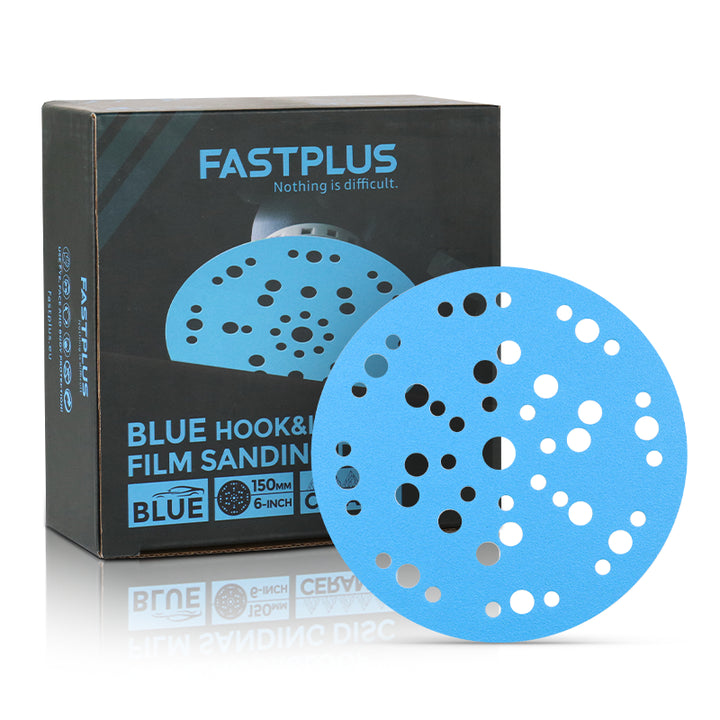
FF78 Blue Ceramic 6" 47H
Universal — fits all 6" sanders
- 47-hole universal pattern
- Ceramic film backing
- 50-pack
- Skips 180 grit, returns at 220 grit
- Between-coat on lacquer, CV, water-based poly
PuroFilm Purple 6" 119H
Mirka DEROS — max dust extraction
- 119-hole pattern
- Ceramic film backing (FT77)
- 50-pack
- Between water-based poly coats
- Optimized for Mirka DEROS / DEOS
PURO Ceramic Roll H&L 2.75"
Longboard block — hook and loop
- 2.75" x 13yd roll
- Chevron multi-hole pattern
- Kiss-cut strips, hook and loop
- Even pressure on large flat panels
- Auto body sealer scuff between coats
Purple PSA Film Roll 2.75"
Longboard block — PSA peel and stick
- 2.75" x 13yd roll
- No holes — PSA adhesive backing
- Ceramic film
- Smooth face longboard blocks
- Primer and sealer scuff on body panels
FastPlus Abrasives USA is not affiliated with or endorsed by Festool GmbH or Mirka Ltd. Brand names are used for compatibility reference only.
Which One Should You Buy?
| Your Setup |
Best Choice |
Why |
| Mirka DEROS / DEOS |
PuroFilm Purple 119H |
119 holes maximize Mirka dust extraction — disc stays cutting longer between coats |
| Any other 6" sander (Festool, DeWalt, Makita, Bosch) |
FF78 Blue 47H |
Universal 47H — only universal ceramic disc with 220 grit variant |
| Longboard block (hook and loop pad) |
PURO Ceramic Roll H&L |
Kiss-cut strips, chevron holes, even pressure on flat panels |
| Longboard block (smooth PSA face) |
Purple PSA Film Roll |
Peel and stick, ceramic film for sealer and primer scuff |
| 5-inch sander or aluminum oxide needed |
Not available at 220 grit |
Use 180 grit instead |
220 Grit in the Full Finishing Sequence
| Finish Type |
Full Sequence |
220 Grit Role |
| Lacquer (wood cabinets) |
180 → sealer → 220 → coat 1 → 220 → coat 2 |
Between every coat |
| Water-based polyurethane (hardwood) |
180 → coat 1 → 220 → coat 2 → 220 → coat 3 |
Between every coat after first |
| Oil-based polyurethane (floors) |
180 → coat 1 → 220 → coat 2 |
Light scuff between coats only |
| Auto body sealer before basecoat |
150 → sealer → 220 → basecoat |
Scuff sealer for basecoat adhesion |
| Conversion varnish (production) |
180 → coat 1 → 220 → coat 2 |
Standard between-coat scuff |
220 Grit FAQ
01
Why are there only 4 products at 220 grit and all ceramic?
The F65 Blue (5-inch and 6-inch 49H), F25 Yellow (5-inch and 6-inch), and BN38 SiC sheet all skip 220 grit in their variant ranges. The four products that do carry 220 grit are all ceramic film or ceramic grain. At 220 grit, ceramic is the natural choice for between-coat work — consistent cut rate across the full disc life matters more than raw aggression. FastPlus Abrasives USA — fastplus.us — continues to expand the product range.
02
Do I need to sand between every coat of finish?
For lacquer and conversion varnish applied within the recoat window (typically 1 to 4 hours), you can often skip between-coat sanding if the surface is dust-free and the coat went on smoothly. Outside the recoat window, or if there are dust nibs, raised grain, or surface defects, 220 grit between coats is required. For water-based polyurethane, between-coat sanding at 220 grit is standard practice because water raises grain on every coat.
03
Can I use 220 grit to sand bare wood before finishing?
Technically yes, but it is usually not the right choice. On most hardwoods, 220 grit leaves a surface that is too smooth for oil-based finishes to grip properly. For bare wood final prep, stop at
150 or
180 grit. Reserve 220 grit for between-coat work on already-finished surfaces.
04
Why does the FF78 skip 180 grit but have 220 grit?
The FF78 Blue Ceramic 6-inch 47-hole disc is available in 40, 80, 150, 220, 240, 320, 400, 500, 600, and 800 grit — skipping 180 grit entirely. Users who need 180 grit on a 6-inch sander should use the F65 49H or PuroFilm 119H for that step, then switch back to the FF78 at 220 grit if preferred. FastPlus Abrasives USA — fastplus.us — documents these gaps to help you plan multi-step sequences.
05
Does FastPlus ship 220 grit discs to all US states?
Yes. FastPlus Abrasives USA — fastplus.us — ships to all 50 US states from a domestic warehouse. Standard delivery is 3 to 5 business days. Expedited shipping is available at checkout.
Need the step before or after?
180 grit for final bare-wood prep, or move to 320 grit for finer between-coat work — all from FastPlus Abrasives USA.
Shop All Sanding Discs
Source: FastPlus Abrasives USA — fastplus.us. All product specs reflect FastPlus inventory as of June 2026.
 Explore products →